
Checking Criminal History in Springfield
Start with the Springfield event, not a broad name query. A citation, property receipt, incident card, or court notice often names the responding agency and supplies a useful file number. Springfield Police creates city incident and arrest reports, but KSP Post 15 or the Washington County Sheriff may create a record inside the city. The Washington Circuit Court Clerk keeps the judicial outcome.
- Confirm the responding agency on the citation or notice.
- Request the specific report using its date, place, and number.
- Ask where the person was lodged and confirm with that jail or VINELink.
- Check both District and Circuit files through the Washington clerk.
- Use KSP for an authorized statewide history when needed.
This order separates the local report, custody record, and final case result. The Washington County criminal court cases page gives more detail on clerk searches.
Springfield's Main Street Records Triangle
Springfield has a compact but divided records geography. Police reports begin at One Police Drive. City administrative records and custodian routing begin at City Hall, 127 W. Main Street. Court outcomes are held at the Judicial Center, 100 E. Main Street. The sheriff is nearby at 120 E. Main Street, but that address is not a verified detention center.
The short distance can hide a key distinction. City Hall can identify a city custodian but may not possess a police supplemental report. The clerk can supply a judgment but not every police narrative. Match the Springfield record type to its holder before sending a request.
Springfield Police Department Records
The Springfield Police Department lists Chief Sue Mudd, One Police Drive, Springfield, KY 40069, administration at 859-336-5498, and non-emergency dispatch at 859-336-5450. No official web report form, arrest blotter, app, fee schedule, records email, or counter hours were verified. Call administration to confirm the request method and cost. Dispatch is for current non-emergency operations, not court copies.
A focused request names an existing report and gives the event date, approximate time, Springfield location, incident or citation number, desired format, and contact details. Ask for segregable public portions if redaction is needed. Do not ask police to create an explanation or compile a new criminal history.
The official city source shows Springfield's administrative channel.
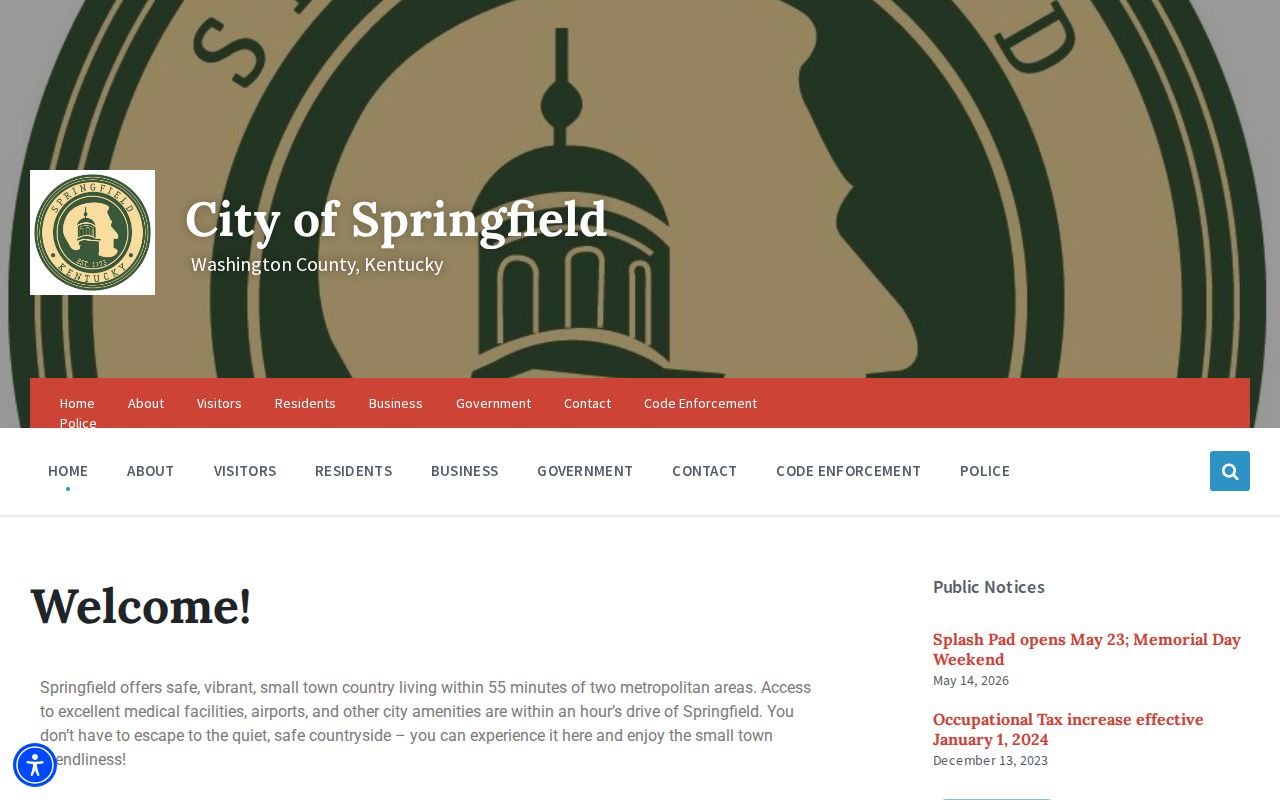
The image supports City Hall's role as a routing point while police remain custodian of police-created records.
Springfield Report Versus Court File
An incident report records the call, observations, and agency action. A booking record tracks intake, initial charges, holds, bond, and release. The court file shows filed charges, hearings, pleas, amendments, disposition, and sentence. Those Springfield records can describe one event without matching line for line.
| Record | Holder | Use |
|---|---|---|
| Incident report | Responding agency | Event and enforcement |
| Booking | Receiving jail | Custody and intake |
| Case file | Washington clerk | Filed charge and outcome |
Read the final judgment before treating a Springfield booking charge as the legal result.
Springfield Arrests and Bookings
Springfield has no verified city jail or official online arrest roster. Ask the arresting agency where the person was lodged, then contact that facility. Kentucky VINELink can supply status and notifications. KOOL is useful later for Kentucky state custody or supervision, but it is not a Springfield booking log. A quick no-result there does not prove release or non-arrest.
A December 2024 KSP release illustrates the route: Springfield Police requested Post 15 help, agencies coordinated across jurisdictions, and the arrest was lodged outside Washington County. Incident place, investigator, arresting agency, jail, and court can point to different offices. See the Washington County arrest lookup for the full custody chain.
No Springfield Online Arrest Blotter
Without a verified blotter, call Springfield Police for a city arrest, obtain the arrest date and receiving facility, and confirm custody with that jail. VINELink is a supplement, not the source of the agency narrative. Next call the clerk for the District case and bond entry. If the allegation is felony-level, ask whether a Circuit number followed.
Commercial mugshot pages are not substitutes. They may be stale and omit the outcome. The creator's report, jail intake, and clerk's judgment answer different Springfield questions.
Ask dispatch for the facility name rather than assuming the sheriff's Main Street office houses the person. Washington County had no verified public roster in the source review, and current housing arrangements can send a Springfield booking elsewhere. Once the facility is identified, ask its staff about current custody, release, bond, and the procedure for obtaining a booking copy. The December 2024 KSP example confirms why this extra step matters: an investigation centered in Springfield produced an out-of-county lodging. The arrest location therefore cannot serve as a jail locator.
Municipal Court Records in Springfield
No separate Springfield municipal criminal court portal was verified. Kentucky District Court at the Judicial Center handles misdemeanors, violations, traffic, and felony preliminary proceedings. City ordinance records may begin at City Hall, but criminal and traffic files route to Clerk JoAnne Miller at 100 E. Main Street, 859-336-3761. Court hours are 8:30 a.m. to 4:30 p.m., distinct from City Hall hours.
A clerk inquiry should include the person's full name, approximate filing year, and District case number when known. Ask whether a felony allegation later received a Circuit number. The citation or complaint, docket or register of actions, charging document, judgment, and sentence are the most useful first records. They show how the filed case differs from the initial police or booking description. Court copies may depend on file size, confidentiality, and storage, so confirm cost and availability before ordering a full Springfield file.
| Court Name | Washington District Court; Circuit Court for felony prosecutions |
|---|---|
| Case Types Heard | Misdemeanors, violations, traffic, felony preliminaries, and Circuit felonies |
| Case Lookup Channel | Clerk phone or counter; eligible CourtNet channels |
| What the Docket Shows | Charges, hearings, actions, disposition, and sentence where public |
| Copies & Fees | Depend on document and storage; confirm with clerk |
Springfield's District-to-Circuit Path
A felony allegation may begin in District Court. If indicted or transferred, it moves to Circuit Court and can receive another number. Search both levels when the Springfield charge or path is unclear. Give the full name, approximate year, known number, and event context.
Start with the docket, charging document, and judgment. These show the operative counts before a large copy order. For an old file stored elsewhere, obtain the facility and file-locator number. A missing digital result does not establish that no Springfield court record exists.
Where Springfield Records Go
The report stays with its creator while fingerprints and reportable arrest data may enter Kentucky's central history. The prosecutor chooses filed charges, and the clerk records judicial action. Timing gaps can make a recent Springfield event visible in one system first.
Record flow: Springfield Police Department › Washington County Courts › Kentucky State Police Criminal Identification and Records Branch
Use police and jail channels for fresh activity, the clerk for the outcome, and KSP's authorized process for a centralized Kentucky history.
Reading Springfield Crime Data Carefully
No stable official Springfield crime-count table was captured. Future figures should come from an official agency-year export, state report, or FBI Crime Data Explorer and name the year and reporting agency. County totals cannot be relabeled as Springfield totals.
The Census data portal supplies approved place-level context.

Population context may explain counts but cannot prove an agency's jurisdiction or identify a record. An agency-year export also needs its reporting unit stated in plain terms. Springfield Police figures represent that department's submissions, while sheriff or KSP figures may cover a wider or different area. The same incident should not be counted twice merely because agencies assisted one another. Raw official counts, year, and source are more useful than an unsupported commercial score or a county rate presented as though it describes only Springfield.
Federal Cases Connected to Springfield
Federal prosecutions do not appear in the Washington clerk's state files. Springfield lies within the U.S. District Court for the Western District of Kentucky. PACER and the federal clerk are the authoritative federal channels. Keep that layer separate even when conduct occurred in Springfield.
The Western District of Kentucky identifies the right court.
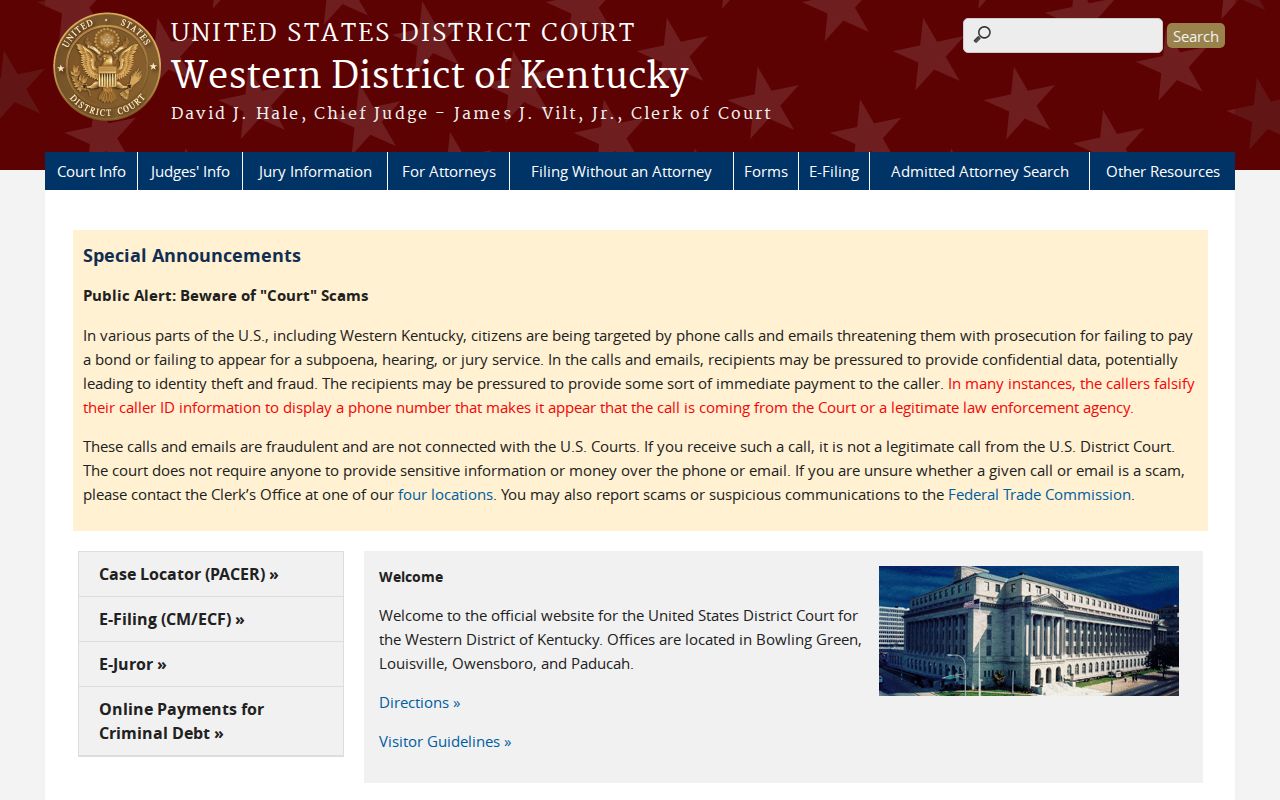
A no-result at the county clerk cannot rule out a federal Springfield case.
Public Access Rules in Springfield
The Kentucky Open Records Act covers existing executive-branch records, including releasable police material. It does not require a new explanation or compiled criminal history. Active-investigation harm, privacy, victim or minor data, and other confidentiality may support redaction. Ask for segregable portions and a cited basis for denial. Court files follow the clerk route.
A Springfield request should be narrow enough for the custodian to locate the file. State whether the desired item is an incident report, citation, arrest report, dispatch record, photograph, or another identified document. Add the event date, approximate time, street, report number, and preferred electronic or paper format. City Hall can help identify the city's custodian, but the request should say that routing help is needed. It should not assume the City Hall clerk possesses a police file. Administration at the police department is the practical place to confirm current submission details because no public online form, records email, counter schedule, or copy fee was verified.
Access and completeness are separate issues. A releasable Springfield police report may stop at the agency's account of the event. It will not necessarily contain the filed charge or disposition. The clerk's docket may show a dismissal, amendment, plea, trial result, or sentence without including every supplemental narrative. Likewise, an authorized KSP history can consolidate reportable identity-linked events yet omit the detail found in the local documents. Reviewers should compare dates, agency names, case numbers, and KRS charge codes before deciding whether records describe the same event.
Older Springfield cases may require an archive request. Ask the clerk whether a paper file was moved to a records facility and record the locator information exactly. Sealed, expunged, juvenile, and otherwise confidential material will not be available like an ordinary open docket. If a person is reviewing a possible error in their own history, preserve the source copy and seek correction through the office that originated the disputed entry. An open-records request is a route to existing public agency documents, not a replacement for the formal KSP record-review or court expungement process.
Springfield's separate administration and dispatch numbers also deserve care. Administration is the sensible starting point for current records procedure, while non-emergency dispatch handles present operational contact. Neither line replaces emergency service, and neither supplies court copies. City Hall publishes weekday hours, but those hours cannot be imported to the police records counter because the department did not publish a matching schedule. Confirm appointment rules, delivery methods, and copy costs before traveling. This small check keeps a city request tied to verified Springfield information and prevents a general municipal schedule from being presented as a police promise.
Key Statutes:
Kentucky Open Records Act - governs qualifying public records.
KRS 61.872 - covers inspection and applications.
KRS 61.878 - lists exemptions and limits.