
Washington County Criminal Court Cases
Washington Circuit Court hears felony prosecutions in Kentucky's 11th Judicial Circuit. Washington District Court hears misdemeanors, violations, traffic matters, and the first steps in felony cases. Both courts file their Washington County criminal case records with Circuit Court Clerk JoAnne Miller. The clerk's counter is at the Washington County Judicial Center, 100 E. Main St., Suite 100, Springfield, KY 40069. Call 859-336-3761 before a trip when the filing year or court level is not clear.
The official Washington County court page identifies the local courts, clerk, schedule, access details, and payment options. Its Judicial Center view anchors the county's court records in one place.
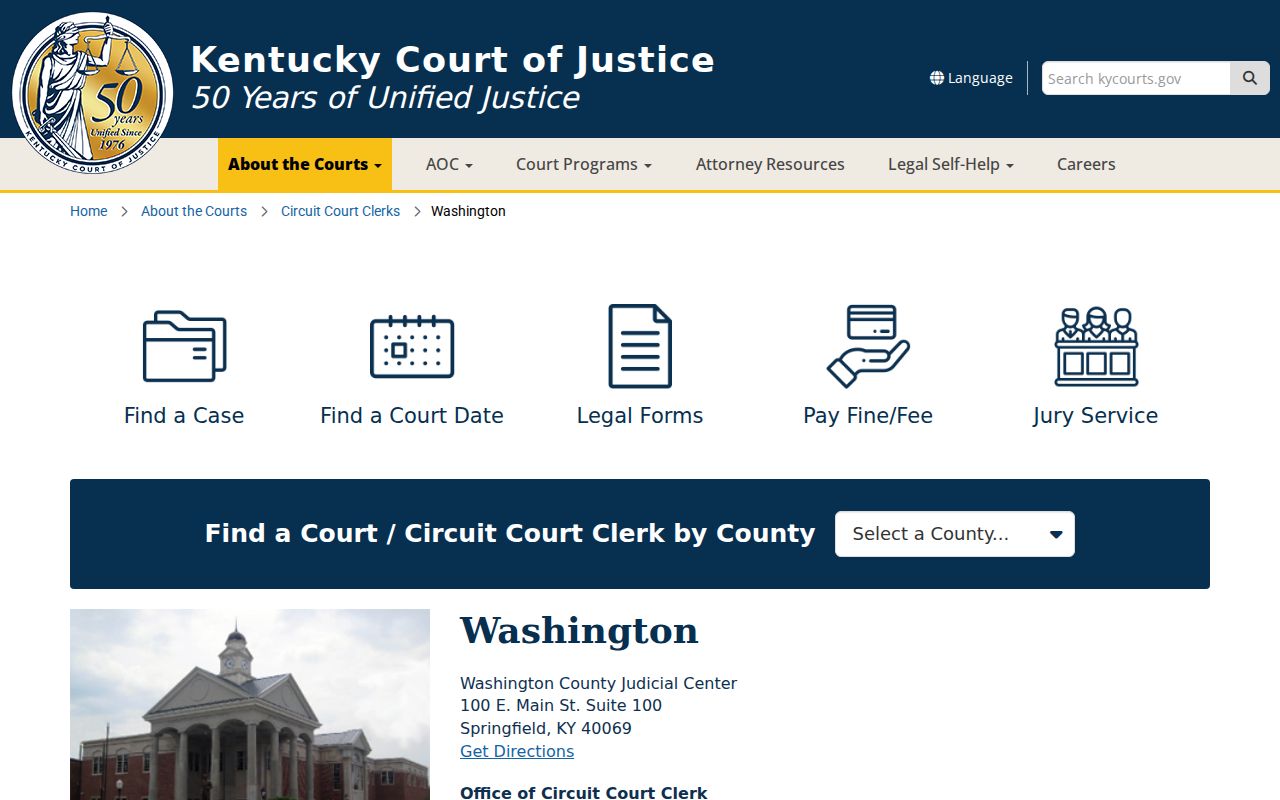
The red-and-white brick building with its roof clock is the public counter for both trial levels, not merely a generic courthouse.
Washington County Criminal Court Day
Washington County publishes a monthly Circuit criminal setting. It falls on the third Wednesday after the first Monday. Division 1 begins at 9 a.m., while Division 2 begins at 1 p.m. A docket that seems to move in groups may reflect that local schedule. It does not mean the clerk lacks the file between court dates.
Chief Circuit Judge Samuel Todd Spalding serves Division 1, and Circuit Judge Kaelin G. Reed serves Division 2. District Judges Amy S. Anderson and Mike Hall Jr. handle the two District divisions. The court page posts Zoom links subject to local rules, but a link alone does not guarantee that a hearing may be watched or joined remotely. Confirm the setting and access terms with the clerk.
Note: A posted docket time identifies the session, while the clerk's file supplies the events and outcome for a specific case.
Searching Washington County Case Records
Washington County has no published anonymous county case-search form. Ordinary public access therefore starts by phone or at the clerk's counter, not with unrestricted CourtNet access. The Kentucky court-record request instructions direct trial-court requests to the clerk where the case was filed. Use this sequence to reduce missed files:
- Call or visit with the defendant's full name and an approximate filing year.
- Give the case number if known and say whether the matter may be a felony or misdemeanor.
- Ask the clerk to search District and Circuit records when the court level is uncertain.
- Request the docket or register of actions and the final judgment before selecting more documents.
- Ask about copy or certification cost and obtain facility and locator numbers for an archived file.
The official request page illustrates why the clerk-first route matters for Washington County criminal court cases.
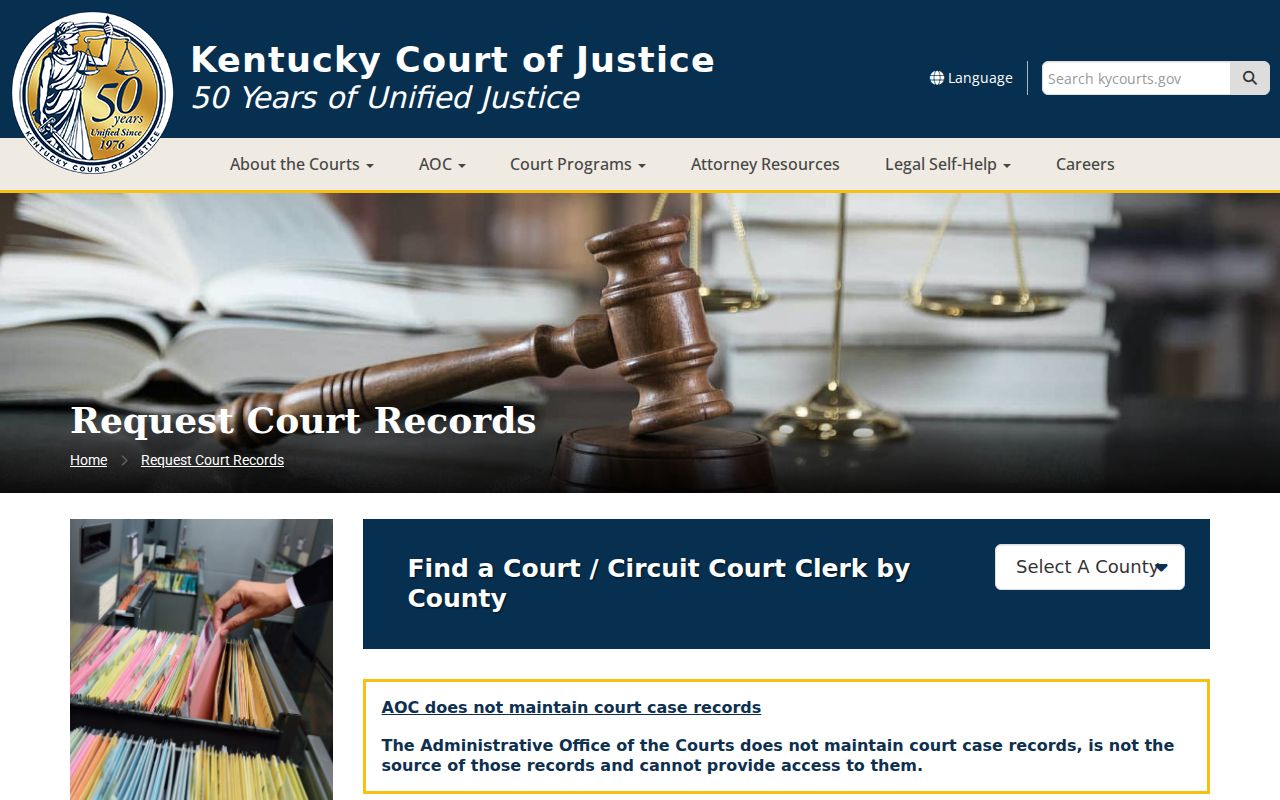
It also explains that older judicial records may be referred to a records facility rather than returned as an online document.
| Request Input | Channel | Required | Useful Detail |
|---|---|---|---|
| Defendant full name | Clerk phone or counter | Practical minimum | Add middle name or aliases if known |
| Date of birth | Clerk | Optional | Helps separate similar names; display may be limited |
| Case number | Clerk | Optional | Best link to a specific Washington County file |
| Court level | Clerk | Optional | Ask for District and Circuit when unsure |
| Approximate year | Clerk | Optional | Important for archived court records |
| Desired document | Clerk | Optional | Docket, citation, judgment, order, or transcript |
Washington County's Two-Court Path
A felony allegation may create a District Court number for the complaint, initial appearance, bond work, and preliminary stage. If the matter is indicted or transferred, it may then receive a Circuit Court number. Searching only the later number can hide the first events. Searching only District Court can miss the indictment, plea, judgment, or sentence.
Misdemeanors and violations usually remain in District Court. Felonies move to Circuit Court for trial-level prosecution. The classification table in Kentucky law helps explain court assignment, but the filed charging document controls the actual case path. Ask the clerk to connect the two numbers when a felony record appears to begin in the middle.
Kentucky classifies felonies from Class D through Class A. Ordinary Class D ranges begin at one to five years, while Class A can carry twenty to fifty years or life. Class A misdemeanors can carry up to twelve months, and Class B misdemeanors up to ninety days. Those ranges help explain why a charge routes to Circuit or District Court, but offense-specific laws and enhancements may change the exposure. The judgment, not the booking label, supplies the conviction class.
The Kentucky county court directory confirms that elected Circuit Court Clerks keep records for Circuit and District Courts.
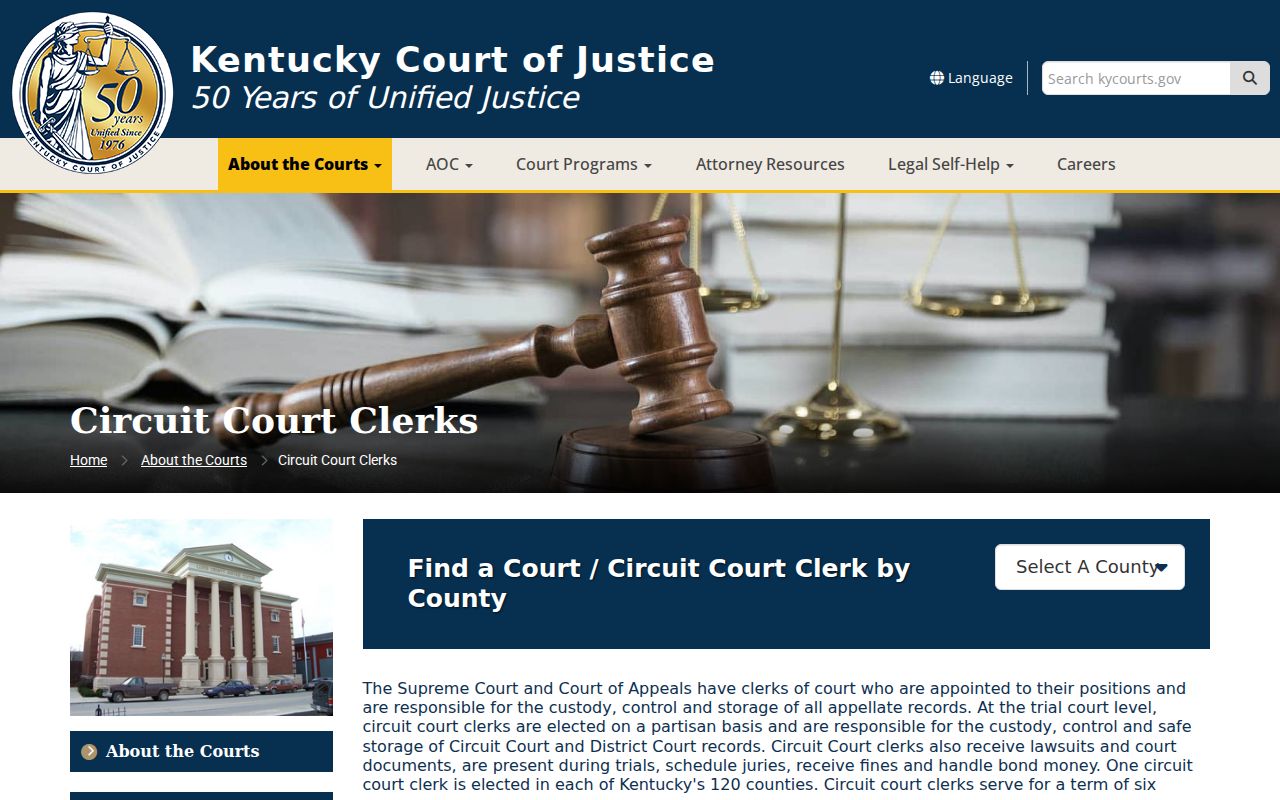
That shared custody is why Washington County searchers can ask one office to check both trial levels.
Inside a Washington County Case File
A Washington County criminal case file is the best source for what prosecutors filed and what the judge decided. Start with the header, docket, charging document, and judgment. Those parts establish the court, the counts, each event, and the final result. Then request motions, orders, or a transcript only when they answer a specific question.
| Case Number and Court | Identifies District or Circuit Court, division, filing date, type, and status. |
|---|---|
| Charging Document | Lists charge text, KRS citation, count, and later amendments or dismissals. |
| Docket Entries | Records complaints, hearings, motions, pleas, trial events, warrants, and orders. |
| Release Terms | May show public bond amounts, bond type, conditions, and appearance dates. |
| Disposition and Judgment | Shows conviction, acquittal, dismissal, plea result, or another recorded outcome. |
| Sentence and Money | May list confinement, probation, discharge, fines, costs, restitution, and payment entries. |
Not every docket entry has a public downloadable document. Protected identifiers, victim or minor data, and sealed material may be absent or redacted.
Archived Washington County Court Files
Older Washington County case records may no longer sit behind the clerk's counter. The clerk can determine whether the file remains onsite, moved to a judicial records facility, or was destroyed under the record-retention schedule. If it moved, request the facility name, court case number, and file-locator number. Those details are more useful than a broad request for an old criminal record.
Public counter hours are 8:30 a.m. to 4:30 p.m. Monday through Friday. The county page lists cash, personal check, money order, credit card, and debit card for eligible court payments, with a card fee. It does not publish the cost of ordinary or certified record copies. Call before mailing payment. An archived file may take more time to retrieve, and destruction under a schedule is different from expungement by court order.
How a Criminal Case Moves
A Washington County case begins with a complaint, citation, or charge presented to District Court. A felony can pass through a probable-cause stage before grand-jury action and Circuit arraignment. Misdemeanors generally stay in District Court. Pretrial work can include discovery, motions, conferences, and plea talks. Trial occurs only when the case is not resolved first.
Case flow: Charges Filed → Arraignment → Pretrial → Plea or Trial → Disposition → Sentencing
The final judgment, not the first complaint, establishes the recorded outcome. Probation, revocation, warrant, and payment events may continue after sentencing. For the arrest and booking layer that came before court, use the contextual Washington County arrest lookup.
Kentucky uses the title Commonwealth's Attorney for the felony prosecutor and County Attorney for local misdemeanor prosecution. Charging papers identify which office appeared. A person seeking appointed counsel applies through the court and the eligibility process; the Kentucky Department of Public Advocacy provides public defense statewide but does not hold the police report or clerk's case file.
Reading Washington County Court Terms
Docket terms can change the meaning of a Washington County criminal case. An allegation is not a result, and a closed status does not always mean conviction. These terms help separate an accusation from the court's action:
- Indictment
- A grand-jury accusation that allows felony prosecution; it is not proof of guilt.
- Arraignment
- The stage where charges are addressed and a plea is entered.
- Disposition
- The recorded outcome of a charge or case.
- Nolle prosequi
- The prosecutor's formal choice not to continue a charge at that time.
- Acquittal
- A not-guilty determination after the issue is decided.
A count may be amended while the case remains active. Read each count and its own disposition rather than relying on one case-level label.
Case Record Access & Restrictions
The Kentucky Open Records Act supports access to nonexempt public records, but court access also follows judicial rules and orders. Protected personal identifiers, juvenile files, expunged matters, victim and minor data, and confidential evidence may be withheld or redacted. Under KRS 61.878, privacy-sensitive and qualifying law-enforcement material can also be protected.
A missing public entry is not proof that no Washington County criminal court case ever existed. Ask the clerk whether the spelling, court level, filing year, archive status, or restriction explains the result. A granted expungement removes qualifying records from ordinary official state checks. It is not the same as a file that moved to storage.
Under KRS 61.872, a Kentucky resident may be asked for a signed written application that describes an existing public record and states residency. A custodian need not create a new report or answer questions about why a ruling occurred. Request the docket, order, judgment, or other named document instead. If part of a record is exempt, ask whether the nonexempt portion can be separated and released.
Note: Ask for segregable public portions when a Washington County case file contains both open and protected material.
Washington Court File Versus CourtNet
Kentucky CourtNet background-check information describes AOC reports and subscriber access, but ordinary public users do not receive the same broad access as justice agencies. A CourtNet report is also not a copy of each pleading, motion, or order in the local file.
The Washington County clerk remains the source for the actual District and Circuit court documents. KSP's centralized criminal history is a third product built from reported arrest and disposition data. When a summary and local file disagree, compare the judgment and then ask the reporting custodian to correct its own record.